What Is Life?
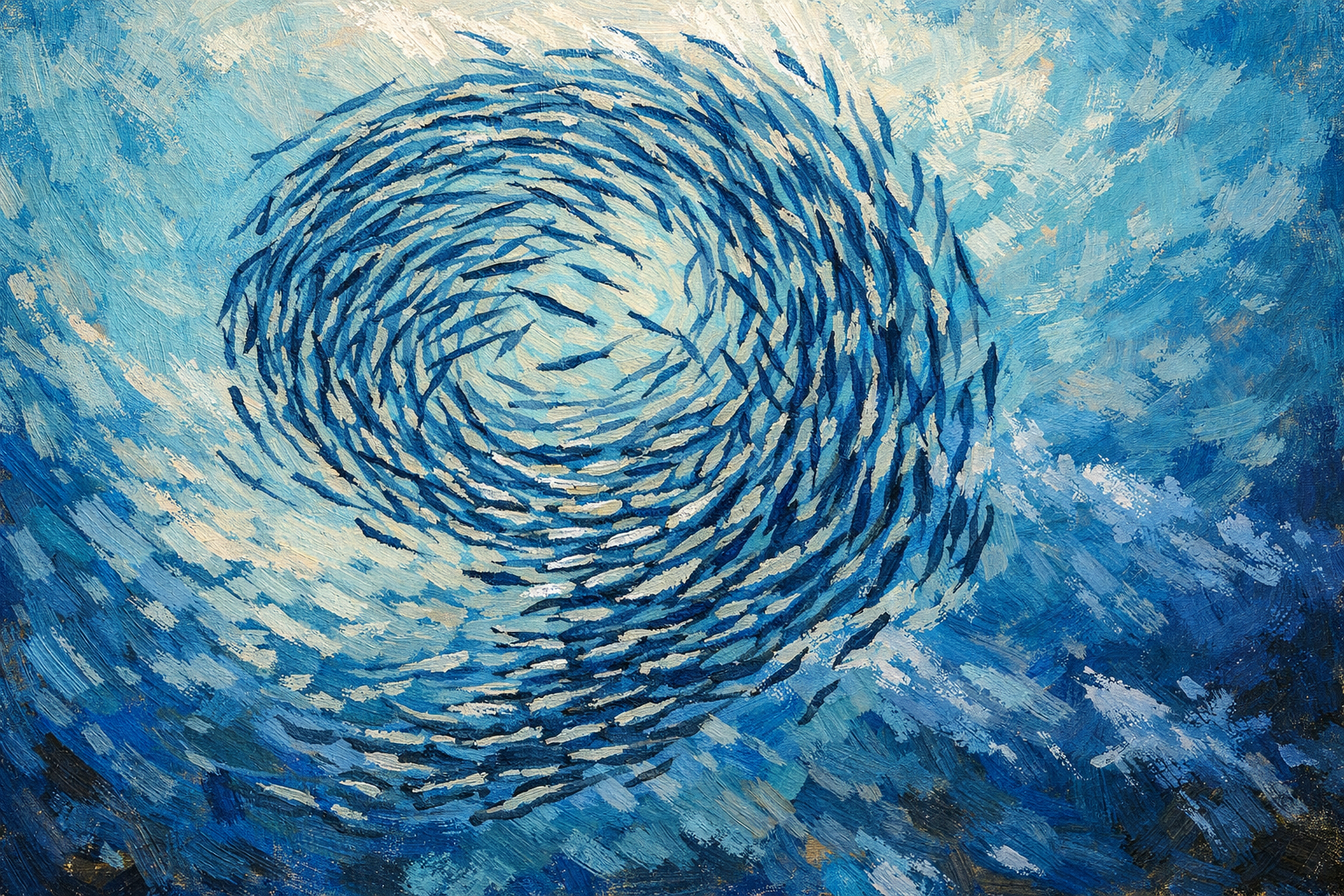
Living organisms are best understood not as a fixed entity, but rather as an ongoing, dynamic process arising from myriad interacting parts forming complex biological networks. These large-scale networks operate through nonlinear dynamics and their components, such as organs, tissues, cells, genes, and proteins, interact and synchronize to generate coherent, emergent patterns of behaviour. Even when governed by deterministic rules, these systems can produce unpredictable outcomes, due to sensitivity to initial conditions and feedback loops, shaping development and evolution. Order does not merely result from external design; it can spontaneously emerge through self-organization, especially in regimes that balance stability with flexibility. Life therefore persists by maintaining structure far from equilibrium, continuously exchanging energy and matter with its surroundings to sustain organization. Across multiple scales, from molecular networks to whole organisms, biological systems process information in ways that integrate robustness with adaptability, while remaining fragile to disease, ageing, and death. In this view, life is an emergent, self-organizing, energy-dissipating network, finely poised between order and chaos. What new forms of computation might arise if biology-inspired artificial intelligence were modelled as a dynamic, self-organizing, adaptive network?
This workshop explores foundational questions at the intersection of biology, philosophy, and artificial intelligence:
- How did living cells emerge from non-living matter?
- How did intelligence emerge from cell-based organisms?
- Can biological intelligence inform better AI systems?
We seek contributions that deepen our understanding of how intelligence emerges from biological systems.
Confirmed Speakers
Schedule
Date: 20 Jul 2026 (Mon)
Venue: Nanyang Technological University (LHS-TR+52 (Level 2). UOB Innovation Hub, 52 Nanyang Ave, Singapore 639816)
- 09:30 – 10:00 Registration and coffee
- 10:00 – 10:05 Welcome statement (Melvin)
- 10:05 – 10:15 Opening statement (Kumar)
- 10:15 – 11:00 Prof. Carlo Cannistraci, Chair Professor, Tsinghua University
- 11:00 – 11:45 Prof. Chew Lock Yue, Professor, Division of Physics and Applied Physics, Nanyang Technological University
- 11:45 – 12:30 Prof. Chandra Verma, Senior Principal Investigator, Bioinformatics Institute, A*STAR
- 12:30 – 13:30 Lunch
- 13:30 – 14:15 Prof. Uttam Surana, Research Director, Institute of Molecular and Cell Biology, A*STAR
- 14:15 – 15:00 Breakout session
- 15:00 – 15:15 Closing statement (Melvin)
Register
If you wish to register, kindly access the registration form and fill in your details. Do note that limited spots are available (up to 30).
Contact
The organizers are Prof. Kumar Selvarajoo (Chief Scientist, Taizhou Institute of Zhejiang University) and Dr. Melvin Chen (Senior Lecturer, Philosophy, Nanyang Technological University). This research is supported by the National Research Foundation, Prime Minister’s Office, Singapore under its Campus for Research Excellence and Technological Enterprise (CREATE) programme. If you wish to contact the organizers, please e-mail Dr. Chen at melvinchen (at) ntu (dot) edu (dot) sg